How much control do you have over your business documents?
Posted on August 10, 2026 • 5 min read • 927 wordsAs your business grows, keeping the right documents in the right hands gets harder. HR Omni Documents helps you stay in control.
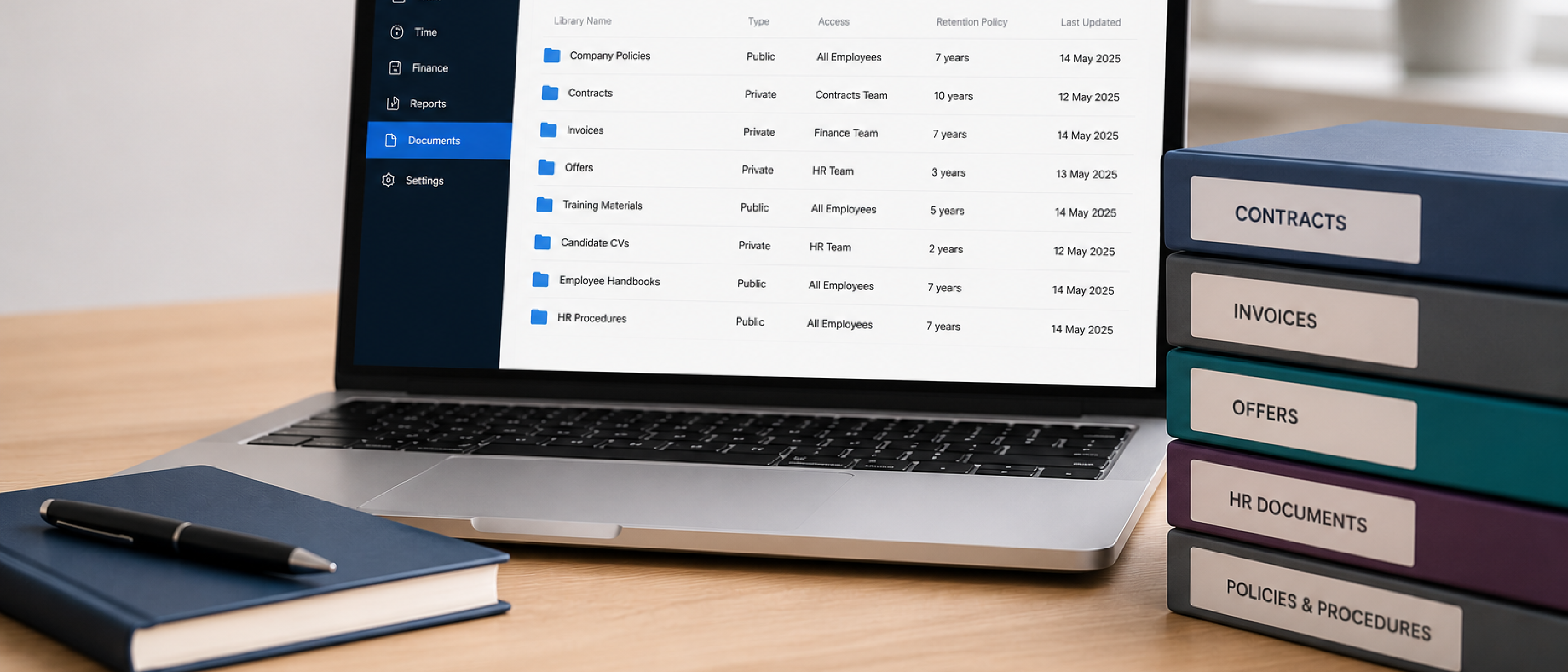
As your business grows, documents have a habit of ending up everywhere.
Contracts might be in a shared drive. Invoices in another folder. Company procedures somewhere else. Employee handbooks, training materials, candidate CVs and sensitive employee records may all have their own homes.
Finding the right document can be frustrating. But there’s a bigger issue.
Who has access to it? Who can change it? How long should it be kept? And if the document contains sensitive information, can you see who has accessed it?
These are some of the problems we’ve built our new HR Omni Documents module to solve.
Different documents need different rules
Not every document in a business should be managed in the same way.
A company procedure might need to be available to every employee. A contract may only need to be accessible to a particular group. An invoice could have a completely different audience.
The same applies to HR documentation. An employee handbook or training material may be widely shared, while an appraisal or other sensitive employee record may need to remain private to managers.
Then there are documents such as candidate CVs, where the business also needs to consider how long that information should be retained.
Putting everything into shared folders and managing access manually can work for a while. As the company grows and more people need access to different information, it becomes much harder to keep on top of.
HR Omni Documents gives businesses a way to put some structure around this.
Give people access based on what they actually need
Documents works alongside HR Omni’s existing role-based access controls, with additional access groups that can be created specifically for document libraries.
This means you can decide who should be able to view documents, who should be able to add or update them, and who should be responsible for managing the library.
You’re not limited to a fixed number of access groups, and multiple groups can be assigned to the same private library.
The practical benefit is simple: someone can get access to the documents they need without automatically getting access to information they don’t.
Share information when it should be shared. Keep it private when it shouldn’t.
HR Omni Documents separates company and employee documentation, with different ways to control access within each.
Public company libraries can be used for information that everyone should be able to access, such as employee handbooks, company procedures or training material.
Private company libraries are there when access needs to be more controlled. That could include contracts, invoices, offers or other business documents that should only be available to specific people.
Employee documentation can also be separated according to its purpose.
A shared employee library can hold documents that both the employee and their manager should be able to access. A private employee library can hold sensitive information that needs to remain visible to managers only.
It means the way a document is managed can reflect what the document actually is, rather than forcing everything into the same structure.
Put retention policies into practice
Another problem with documents scattered across folders and systems is that they can stay there long after anyone has thought about whether they should.
Candidate CVs are a good example.
A company may decide that candidate information should be retained for a particular period based on its applicable legal requirements and internal policies. Instead of relying on someone to remember to go through a recruitment folder later, the CVs can be placed in a library with an appropriate retention policy.
Each library in HR Omni Documents can have its own retention policy, and a company can create as many policies as it needs.
Different documents can therefore be managed according to different retention requirements.
HR Omni doesn’t determine what the correct legal retention period is for a particular document. The business makes that decision. Documents gives you a way to apply the policy you’ve chosen.
Know what’s happening with your documents
Giving someone permission to access a document tells you what they’re allowed to do.
Sometimes you also need to know what they actually did.
Read and write activity within HR Omni Documents generates an audit log, so access to documents can be reviewed.
That’s particularly useful when you’re dealing with confidential or sensitive information.
As more people become involved in managing company information, having that record gives the business a clearer view of how documents have been accessed and managed.
Why we built Documents
We didn’t want to build another place to upload files.
There are already plenty of places to store a document.
The harder problem is keeping control once you have hundreds or thousands of them, different people need different levels of access, and some information needs much tighter handling than others.
That’s where HR Omni Documents fits.
It gives businesses one place to manage company and employee documents while putting their own rules around access, retention and accountability.
A handbook can be available to everyone.
A contract can be restricted to the people who need it.
An employee can access documents intended to be shared with them without seeing confidential management records.
Candidate CVs can have their own retention policy.
And when you need to review activity around a document, there’s an audit record to refer to.
As your organisation grows, those distinctions matter.
HR Omni Documents is now available.
If documents are becoming harder to organise, control or keep track of as your business grows, talk to us and we’ll show you how HR Omni Documents works.